

The Royal Mint today houses one of the most complete numismatic collections in the world. Its unique character demonstrates a continuous and laborious development over time, which also implies a great adaptation to the pace of recent innovations and a singular sense of dissemination through its resources that makes this museum a unique experience. To learn about its establishment history, we approach its rooms and observe the layout it presents from a museological perspective.
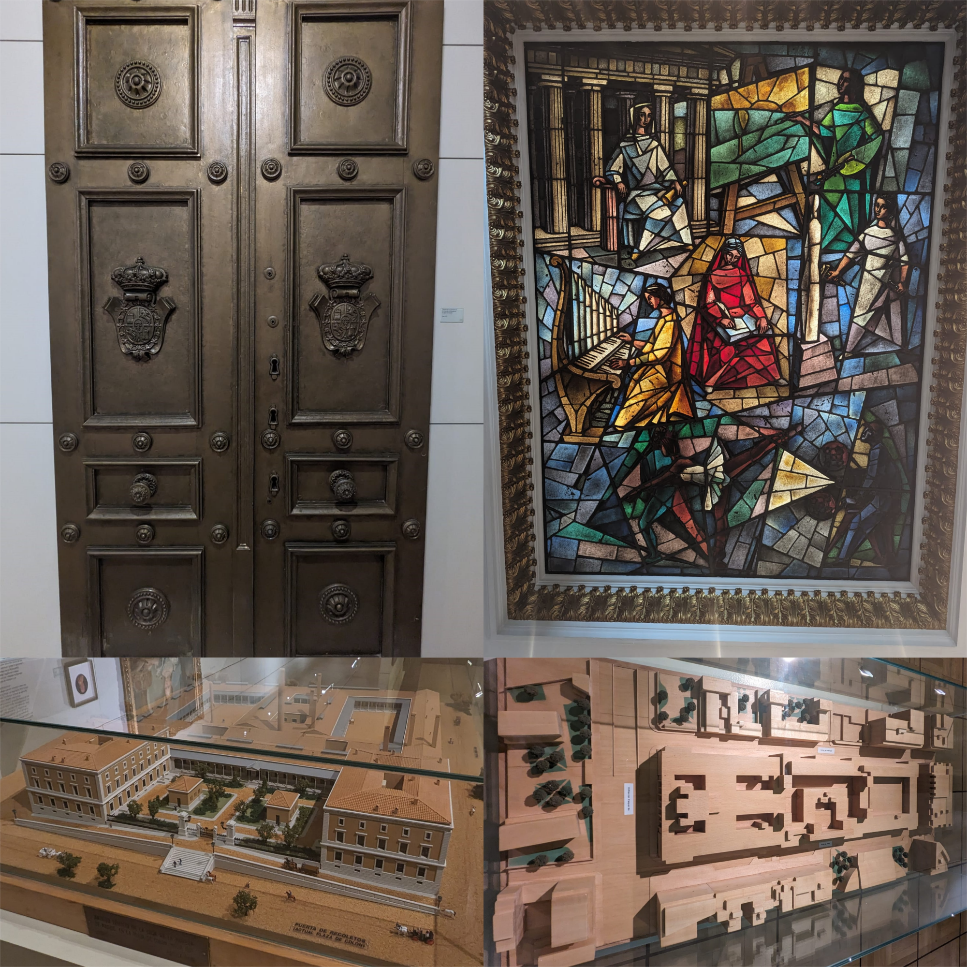
The museum itself of the National Mint and Stamp Factory bears witness to the fact that its origin centers around the figure of Tomás Francisco Prieto (The Casa de la Moneda Museum), who during the middle of the eighteenth century was the engraver general of the royal mints for King Charles III, as well as director of engraving at the Royal Academy of Fine Arts of San Fernando and founder of a school of engraving for subsequent professionals in Spanish and Indian mints. The collections to which Prieto dedicated his entire life constituted the genesis for a necessary building that would house all his legacy and those that followed.
The first recorded evidence of a mint in Madrid territory is during the reign of Henry IV, existing between 1467 to 1471, but little information is known about its whereabouts. Although from the seventeenth century a mint was established in Madrid, which split into two buildings on Segovia Street, it wasn't until the beginning of the eighteenth century when new proposals began for changing establishments due to the poor condition these original buildings were in and also because of the importance this Madrid mint gained after being refounded by the Bourbons (Feria, 2003, pp. 72-73).
Furthermore, the donation of Prieto's collections would exacerbate this need, as following his death in 1783, new acquisitions and donations related to patent materials were incorporated, thus forming a larger fund of coins, medals, engravings, seals, books, and other historical pieces. This made it increasingly imperative for their transfer to an adequate organization and documentation conservation due to its magnitude and indispensable technical classification to avoid errors such as possible counterfeits (Feria, 2012, pp. 359-361).
The project for the construction of a new headquarters in Madrid was not processed until 1855, when it was proposed to the Cortes and amended in 1856. Turbulent times during which other Spanish mints were at risk, such as those in Seville, Barcelona, and Segovia, due to an attempt to unify all numismatic amalgamation into a single residence causing a debate that did not result in the intended proposal but still sought centralization of the mint in the capital city (Torres, 2016, pp. 145-159). Finally, for eight million reales, the new Madrid mint was established on Plaza de Colón, near the National Library.
After its installation in 1861, the monetary cabinet underwent a noticeable reinvention and it opened to the public for the first time in 1867, during Queen Isabella II's reign (Feria, 2003, p. 73). Inside the Casa de la Moneda building, the Stamp Factory was also operating, and in 1893, both entities merged to form the National Mint and Stamp Factory, which continues to operate today.
Just a century later, despite surviving the Civil War building, in 1964 it was moved to its current location (Gimeno, 2016, p. 190), which responds to rationalist architecture with two entrances: one on Jorge Juan Street and another on Doctor Esquerdo Street. At that time, the Mint and Stamp Factory was also dedicated to issuing banknotes for the Bank of Spain, thus understanding a new structure.
Regarding the National Mint Museum, the law project granted the previous year supports its promotion with necessary concessions to create a gallery at par with international museum works and recognize it as such with its relevant parameters. This project, called "Regulation for the Museum, Library, and Archive of the Factory," is essential to understand the functioning of the Casa Museo de la Moneda until today, making pertinent modifications in subsequent years regarding exhibitions, administrative matters, funds, and complementary services to the museum.

The exhibition would be arranged for public visit with good security and conservation of the pieces, along with explanatory sketches in each room and convenient visibility. The glass ceiling windows, which contrast functionally with their exterior appearance, have a modernist touch, are part of the original building construction. In the adjacent rooms of the permanent exhibition, some covers were used that allow glimpses of these colorful glasses, incorporating appropriate lighting for observation and preservation of the displayed pieces. Every item must have an information card with its corresponding reference, showing either the reverse or obverse side of coins, medals, seals, and banknotes, intercalating their variety to add dynamism, which is one of the goals.
Rafael Feria y Pérez (2003), current director of the Casa de la Moneda Museum, promulgates in his thesis an exhibition plan for a museum that endures through its activities and promotes money history to the general public. In this way, it is important to have an exhibit language that condenses what needs to be conveyed and also labels, visual graphics, and evocative materials that contextualize more simply, from ration coupons to period rooms.
Interactions are also necessary, such as the opportunity offered to strike a coin with a hammer, and other participatory activities that make visitors process what they have learned (Feria, 2003, pp. 97-116), all designed to bring culture closer to different groups. Ultimately, whether one is an expert or just curious, the person who accesses the numismatic museum's collection should leave renewed.

It is undeniable that the Casa de la Moneda Museum has roots and has experienced various changes throughout its existence. Its relocation was a consequence of several circumstances, marking it numerous times, so it was necessary to establish the foundations for properly safeguarding its heritage and ensuring that as an authentic museum, it would carry out exhibitions aimed at all audiences, where dissemination is thoroughly employed. One could say that the proverb "I hear and forget. I see and remember. I do and understand" is the driving force of the Royal Casa de la Moneda. Thus we encourage you to visit Doctor Esquerdo Street number 36.
Bibliography
Cano Borrego, P. D. (2018-2019). The accounting of Spanish mints in the eighteenth century. Numisma: revista de Estudios Numismáticos, 262, 157-169.
Domínguez Bazán, V. (2023). The "house-museums" or museums of atmosphere: typology in Spain. ArqueoTimes. /articulos/las-casas-museo-o-museos-de-ambiente-tipologia-museografica-en-espana/
Feria y Pérez, R. J. (2003). Museology and monetary museography: a methodological and functional proposal, Universidad Complutense de Madrid. https://docta.ucm.es/entities/publication/c5463751-c009-4a45-a56c-06453cb9aaa6
Feria y Pérez, R. J. (2005). Monetary museums for the new millennium. XIII International Numismatic Congress, 129-133.
Feria y Pérez, R. J. (2012). The researcher facing numismatic forgery. La Moneda: Investigación numismática y fuentes archivísticas, 356-388.
Gimeno, J. (2016). Documents for the history of the National Mint and Stamp Factory Museum. Numisma: revista de Estudios Numismáticos, 260, 189-213.
The Casa de la Moneda Museum. https://www.museocasadelamoneda.es/
Torres, J. (2016). Procedure in the Cortes of the project for the construction of a new Casa de la Moneda in Madrid (1855-1856). Numisma: revista de Estudios Numismáticos, 260, 135-187.


Comments