

In 1917, while the world was engulfed in a devastating war like never before seen, a revolution ended the autocratic regime of the Russian Tsar, giving rise to the first socialist state in the world and changing history forever.
The new regime had from the beginning an expansive ideological vocation, which alarmed European chancelleries due to the risk of contagion. But when famine spread through the "Soviet paradise" in 1921, killing millions of people (Llewellyn, 2015) and demonstrating that the new regime was incapable of providing what it had promised to the "people," fear began to dissipate.
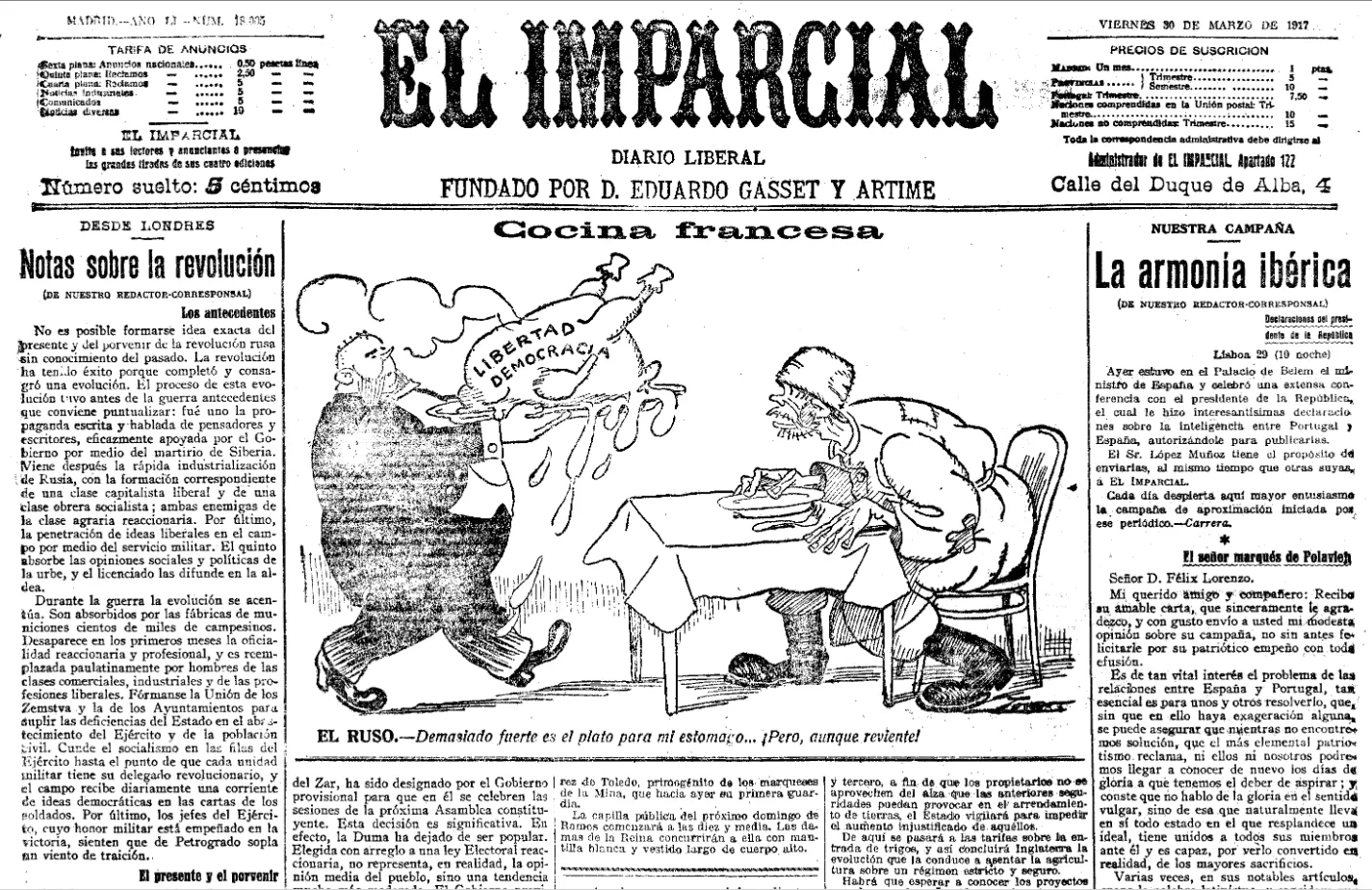
And in Spain?
The fear of the spread of revolution also reached our country. Among the political class there were two clear lessons. The first was that it was necessary to carry out social reforms to prevent the expansion of the revolution in Spain. The other, more conservative, was the need for a more authoritarian attitude to prevent contagion (Avilés, 2000, p. 118).
On the contrary, part of the progressive intelligentsia understood that it was necessary to support the revolution as something useful for renewing society, given that liberal systems had failed. This sympathy was more evident among republican groups and specifically among the Catalan Republican Group, which even considered supporting the revolution to drag in workers' unions, considering the possibility of creating a Catalan Republican Communist group to achieve this union, and as early as 1920, the possibility of adhering to the Third International. But the drastic 21 conditions demanded from Moscow for entry made adherence impossible (Avilés, 2000, p. 124).
The PSP had an ambiguous attitude at the beginning of the Russian Revolution. As a party more aligned with the Allied cause, it supported this position but was also wary of Russia's possible withdrawal from the war. This made it silent for several months (Almuiña, 1997, p. 210).
However, with the signing of the armistice, there was no longer a need for the PSP to support bourgeois governments and it therefore showed clear support. The first sign was during the February 1919 conference of the Socialist International in Bern, where in response to the Swedish delegate's proposal to condemn the Bolsheviks, stating that the advance of socialism must be only through peaceful means; Besteiro, the Spanish delegate, defended another proposition rejecting condemnation by saying there was insufficient evidence (Avilés, 2000, p. 17-31). This hesitant position of the PSP faced a tough test shortly after when the Third International or Communist International was created in March of that year.
By July of that same year, the Madrid Socialist Grouping, requested from the party executive the holding of a referendum for adherence to the Third International. The elderly Pablo Iglesias saw this as a potential path to fracturing the party and diverted the topic towards the celebration of an extraordinary congress (Avilés, 2000, p. 126).
The extraordinary congress was held in December 1919, but faced with debates threatening to provoke a split in the party, the decision on adherence or not to the Third International was postponed by a narrow margin until another congress could be held in June of 1920. What could not be avoided is that the Youth Socialists did adhere, founding several members in April of that same year of 1920 the Spanish Communist Party.
In this new congress it was taken for granted that the PSP would adhere to the Third International, but opposing delegates managed to negotiate adherence through a series of conditions ensuring the independence of the PSP from Moscow. At heart, they sought to avoid adherence as Moscow demanded 21 conditions for it, which completely prevented any type of independence of the parties. On the other hand, the UGT, in its congress, rejected adherence outright (Sueiro, 2002, p. 266).
The Spanish delegates, including Fernando de los Ríos and Anguídano, arrived in Moscow in October of 1920. The trip served to confirm that Moscow was inflexible with its conditions but also that "the socialist paradise" was not such. Repression, hunger, etc.
It was at a third congress held in April of 1921 where the PSP approved by 8,808 votes against 6,025, adherence to the Vienese International, a third way that soon merged with the Second International. In response to this new move, dissenters decided to found the Workers' Communist Party, confirming the split that Pablo Iglesias had feared so much (Sueiro, 2002, p. 266).
And what about the anarchists? At first they were favorable to the revolution. The news arriving from the actions of the new state seemed to coincide with their ideology of freedom.
In December 1919, a national congress of the CNT was held where by acclamation it decided on provisional adherence to the Third International, while observing the evolution of events, sending Ángel Pestaña as delegate to the Second Congress of the Communist International, held in Moscow in 1920. During this trip he realized that the independence defended by the CNT was incompatible with the principles of the Soviet regime (Avilés, 2000, p. 24).
Upon returning to Madrid, he found that the CNT was facing great repression. Part of its leadership had been arrested allowing a new generation of young people more sympathetic to the Bolshevik movement to rise in the union, including Andrés Nin.
In the summer of 1921, the I Congress of the Red International of Labor Unions was held. Four delegates from the CNT, representing this new pro-Soviet direction, including Andrés Nin, attended. During the congress, the CNT delegates unsuccessfully attempted to have freedom principles approved (Avilés, 2000, p. 28).
Nin could not return to Spain due to being sought for his involvement in an assassination attempt on President Eduardo Dato, and remained in Russia along with Ramón Casanellas, also implicated in the attack.
The rest of the CNT delegates upon their return to Spain found a hostile climate from the union which now wished to break ties with Moscow. However, the semi-clandestine situation they had to operate under made it difficult to take a decision until June 1922 when the CNT decided to break with Moscow (Avilés, 2000, p. 29).
Conclusions
We can say that the Russian Revolution initially caused sympathy in general among left-wing groups and workers' movements. However, as news of repression and centralizing moves by new Soviet authorities arrived, this enthusiasm waned in most cases. Within worker groups it also represented a test of fire. For the PSP it meant its split, and the birth of the Communist Party. And for the CNT a disappointment after an initial moment when it seemed that on the fringes of Europe their revolution was taking place.
Bibliography
Almuiña, C. (1997). The image of the Russian Revolution in Spain (1917). Investigaciones Históricas: Época Moderna y Contemporánea, 17, 207-218. https://dialnet.unirioja.es/servlet/articulo?codigo=66423
Avilés, J. (2000). The impact of the Russian Revolution on Spanish workers' organizations (1917-1923). Espacio Tiempo y Forma Serie V Historia Contemporánea, 0(13), 17-31. https://doi.org/10.5944/etfv.13.2000.3027
Avilés, J. (2000). The impact of the Russian Revolution in Spain, 1917-1922. In J. Tussel, J. Avilés & RM.Pardo (Eds), The foreign policy of Spain in the twentieth century (pp 117-133).
Llewellyn, J. and Thompson, S. (February 2, 2015). The great famine of 1921. Alpha History. https://es.alphahistory.com/russianrevolution/great-famine-of-1921/
Sueiro, S. (2002). The disintegration of the system, 1914-1923. In Political history 1875-1939 (pp. 245-282). Istmo


Comments